


This report was originally published in Greg Rowland’s Research Report.
Affordable specialized senior housing (memory care, skilled nursing, etc.) is in a crisis in the United States. The average Social Security monthly benefit is $1900. Memory care averages $6000 to $8000 in the United States. Clearly, America has a massive affordable housing crisis for people with Alzheimer’s and other dementias.
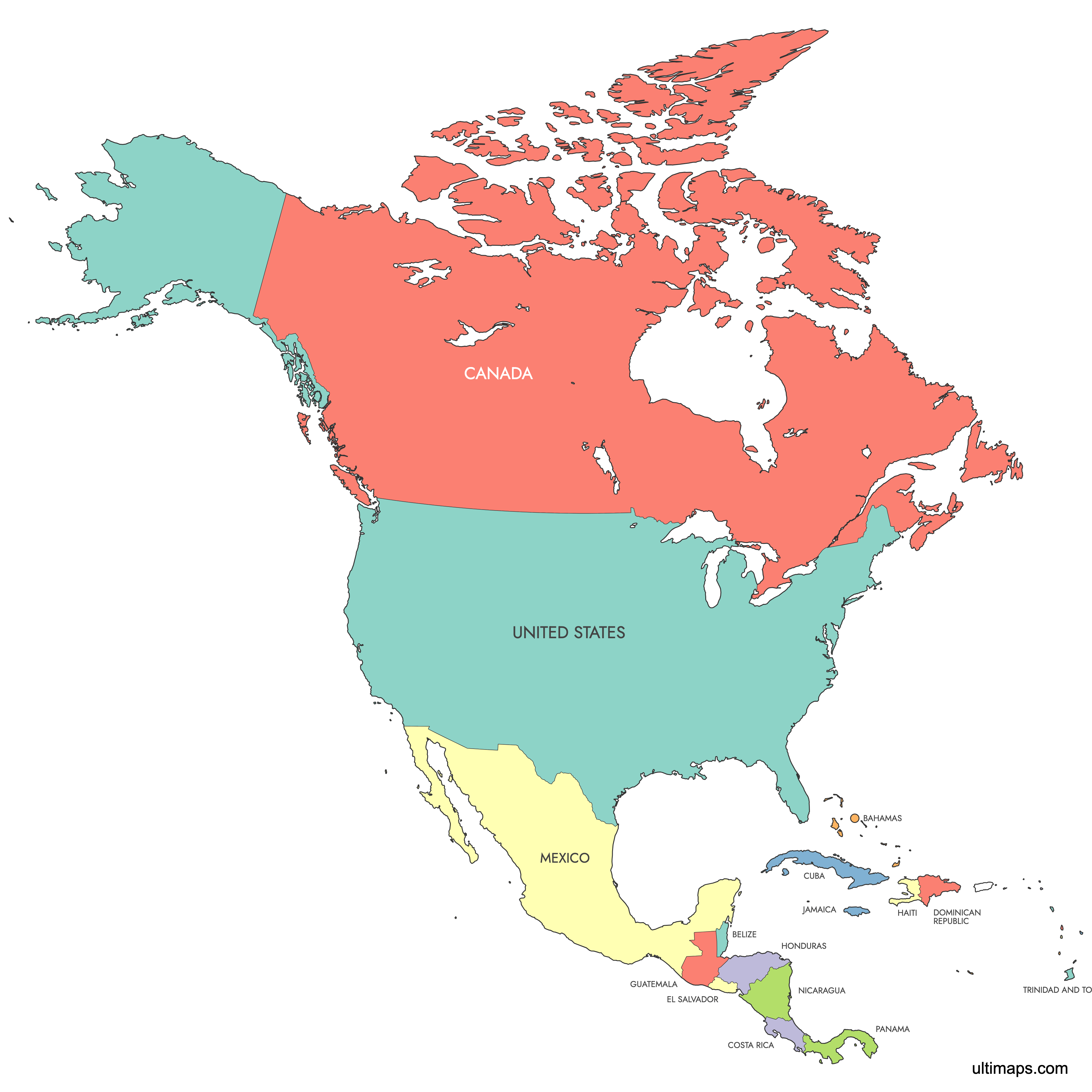
How does the United States compare to Canada and Mexico in supporting their aging populations - especially, those persons with Alzheimer’s and other dementias?
A distinct difference between the three countries is that the United States treats long-term custodial care as a private consumer product rather than a public health or social infrastructure responsibility.
The United States Senior Housing & Dementia Crisis
The Custodial Care Exclusion
Medicare covers acute medical events and short-term rehabilitation (up to 100 days), but it excludes ongoing custodial supervision and memory care.The Medicaid Spend-Down Trap
Medicaid is a joint federal and state program that covers medical costs and long-term nursing home care for low-income seniors. However, eligibility rules vary by state and are notoriously onerous. To qualify, most seniors must “spend down” their life savings to roughly $2,000 in countable assets, effectively forcing middle-class families into poverty before help arrives.The Forgotten Middle
Middle-income seniors are too wealthy for HUD Section 202 or Section 8 low-income apartments—which do not provide memory care anyway—yet they cannot sustain $75,000 to $100,000 per year in private facility costs.Long Waiting Lists
Even after a family exhausts its savings to qualify for Medicaid, seniors often face multi-year waiting lists for an available bed, especially in states that rely on limited Medicaid waivers to cover assisted living and memory care.
Canada: Universal Care vs. Access Bottlenecks
Separating Medical Care from Shelter
Unlike the United States, Canada provides 24-hour nursing and dementia care in Long-Term Care (LTC) homes that are publicly funded under provincial health plans, regardless of a resident’s net worth.Asset Protection & Income-Tested Co-Payments
Canadian dementia patients pay only a government-capped accommodation fee—roughly $1,900 to $3,900 CAD per month depending on the province and income—without having to liquidate their life savings. Low-income seniors are further supported by Old Age Security (OAS), a universal pension based on age (65+) and years lived in Canada, and the Guaranteed Income Supplement (GIS), a non-taxable monthly top-up for low-income OAS recipients.The Canadian Trade-Off: Waitlists & Hospital Gridlock
Universal coverage creates severe supply bottlenecks. Multi-month or multi-year LTC waitlists cause “Alternative Level of Care” (ALC) gridlock in hospitals, leaving many families to manage high-acuity dementia at home—or pay steep rates in private retirement homes—while waiting for a public bed.
Mexico: Family Infrastructure & Universal Cash Transfers
Non-Institutional Care Philosophy
Mexico avoids massive public nursing home expenditures by relying on multigenerational family caregiving and universal cash support rather than facility subsidies. This model is rooted in a strong cultural expectation of caring for aging relatives at home.Direct Income & Cost-of-Living Relief
The Pensión para el Bienestar is a universal, non-contributory cash pension paid to Mexican citizens starting at age 65. Seniors can also enroll in the INAPAM (Instituto Nacional de las Personas Adultas Mayores) discount card program, which reduces costs on food, transit, clothing, property taxes, and healthcare. Most pharmacies discount prescriptions—which are already far cheaper than in the U.S.—and many doctors and dentists offer reduced rates to cardholders.The Dementia Gap in Mexico
Public long-term care facilities (asilos) are strictly limited to indigent seniors without family support. Specialized memory care exists, but it is confined to a small, private-pay sector.
Cross-Border Retirement Migration: The Informal Release Valve
Geographic Arbitrage as Policy Escape
U.S. and Canadian retirees can take their earned pensions (Social Security, CPP, and OAS) with them if they move to Mexico. There, private memory care and live-in nursing staff often cost $1,500 to $3,000 USD per month—a fraction of U.S. rates. For example, rates at Buhayra Assisted Living in Lake Chapala start around $1,500 to $1,800 USD per month for basic assisted living and scale up to $3,000 to $4,000+ USD for full nursing care.The Portability Trap
Lost Benefits: U.S. Medicare and Canadian provincial health plans do not cover routine or long-term care in Mexico. Furthermore, U.S. SSI and Canadian GIS payments cut off after extended absences abroad.
Rising Barriers: Mexico has significantly raised financial solvency requirements for residency visas, and private international health insurance becomes prohibitively expensive—or unavailable—past age 75.
The “Reverse Migration” Crisis
Expats who develop advanced dementia in Mexico and must return north face severe policy friction. Returning Americans who opted out of Medicare Part B face lifetime late-enrollment penalties and sudden Medicaid spend-downs, while returning Canadians often face provincial health insurance waiting periods during a medical emergency.
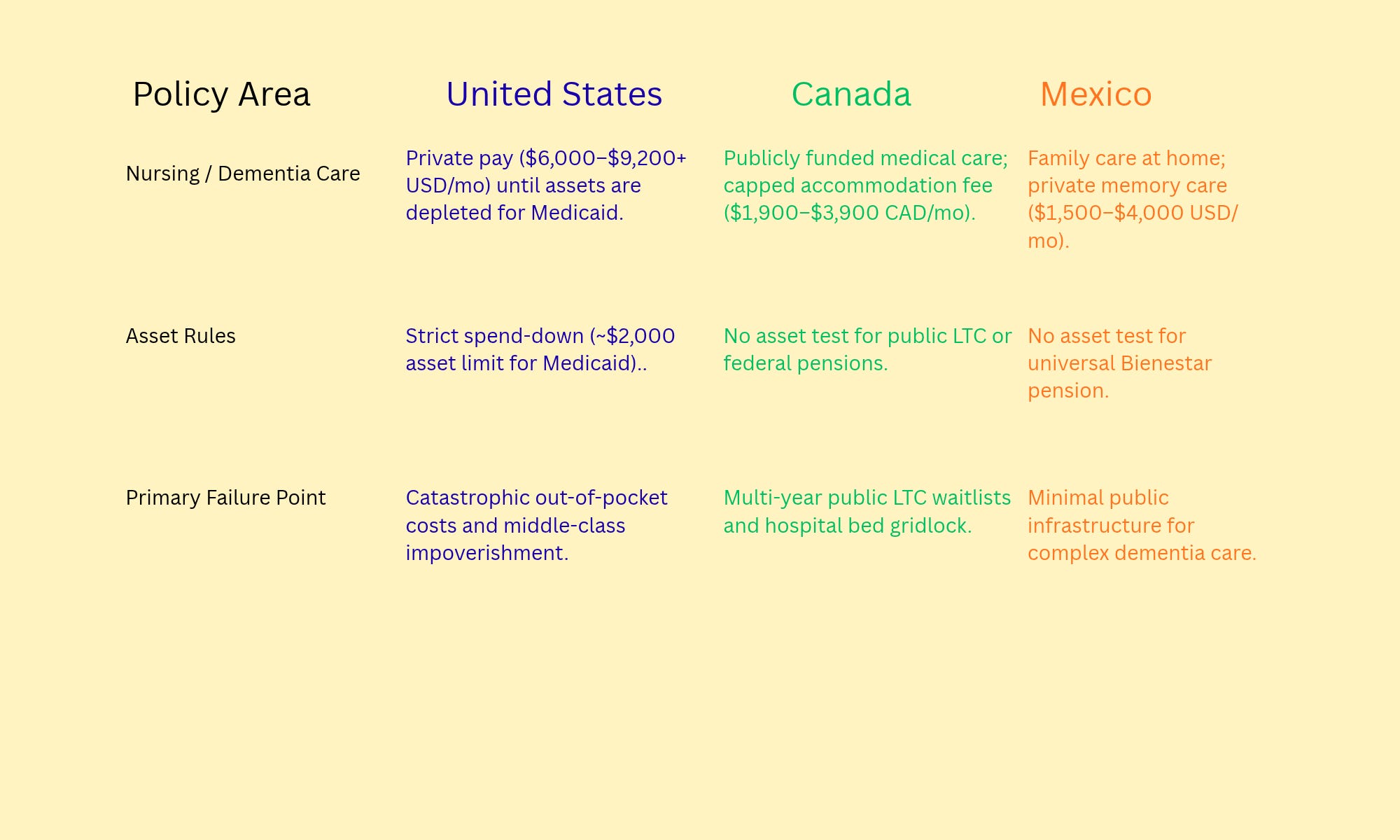
At a Glance: North American Senior Care Models
Summary & Outlook
United States: The cost of a semi-private room in a United States nursing home averages $8,600 to $9,200+ USD/month ($104,000–$110,000+/year). According to KFF (Kaiser Family Foundation) data, Medicaid is the primary payer for roughly 6 in 10 nursing home residents - most of whom entered as private-pay residents and exhausted their life savings.
Canada: Public Long-Term Care (LTC) in Canada is regulated so that middle and high-income seniors pay a capped monthly rate—for example, roughly $1,900 to $2,800 CAD/month in Ontario (depending on basic vs. private room) or up to ~$3,900 CAD/month in British Columbia (scaled at 80% of after-tax income up to a maximum cap). Low-income seniors receiving GIS have their co-payment automatically reduced so they retain a guaranteed monthly “comfort allowance.”
Mexico: Mexican citizens largely take care of family members at home. Seniors receive a cash pension and the INAPAM discount card.
Clearly, none of the three North American countries has a perfect system for housing and caring for aging citizens—each carries distinct trade-offs.
Objectively, however, the United States faces an acute housing crisis for people living with Alzheimer’s and other dementias. This crisis is compounded by long-term uncertainty surrounding Social Security and our enormous national debt. If common-sense solutions—such as expanding affordable supportive senior housing and reining in out-of-control federal deficit spending—are not implemented soon, senior homelessness and despair will dramatically increase in the coming years.
Upgrade Your Subscription To Keep This Publication Sustainable.
Basic (Free): A weekly digest published every Friday summarizing the highlights of the Sunday through Thursday posts.
Standard ($5/month or $50/year): Access to all posts published Monday through Thursday, plus the special new Sunday Sentiments edition.
Supporter ($300/year): All Standard benefits, plus one telephone or video consultation with me per month. We will discuss any subject you choose.