


Happy Friday, everyone.
This will be the last full Friday essay. Next Friday, November 27, will be the first weekly summary. If you have not upgraded to a paid subscription, please consider doing it today. The subscription details are at the end of today’s essay.
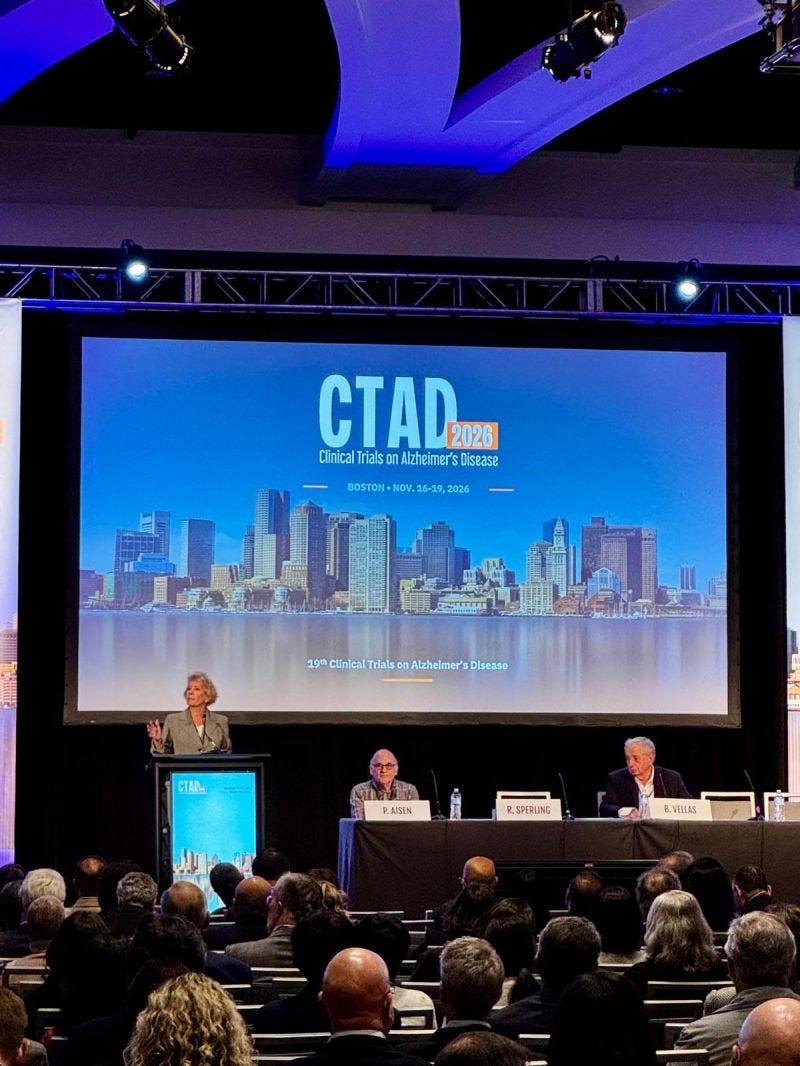
The Clinical Trials on Alzheimer’s Disease (CTAD) conference was held this week in Boston. I did not attend in person, but I carefully followed the presentations. As a person with Alzheimer’s, the reports presented at CTAD were extremely encouraging. Alzheimer’s research is moving rapidly, and it is exploring new avenues.
Early detection technologies and methodologies were widely discussed at CTAD. It is clear that early detection and prevention of Alzheimer’s are a core part of the goal to reduce the global expansion of the disease.
Clinical trial data was released for several emerging new Alzheimer’s therapies, and Eisai/Biogen released a five-year-long-term extension lecanemab study. 1 Actually, they released a partial study of 351 people who stayed on lecanemab for five straight years. Eisai and Biogen released the good stuff, partially released the not-so-good stuff, and they created confusion in the scientific world. The report is being hotly debated as I write this morning.
My greatest takeaway from CTAD is how important the millions of people involved in Alzheimer’s research are. Everyone from research administrative assistants to scientists is part of the global effort to find the answers that may eventually result in a cure for Alzheimer’s. There are an untold number of students passionately pursuing a future focused on Alzheimer’s.
Utilizing advanced technologies, scientists are collaborating and sharing vital data. AI speeds the analysis of data. Helping to reduce the financial risk involved with Alzheimer’s research is the Dementia Discovery Fund. Most importantly, research is moving beyond amyloid. Drugs targeting tau, inflammation, and Alzheimer's psychosis showed early study data this week.
My real heroes are the scientists and physicians who are blazing these new research pathways. Earlier this week, I profiled Neuropep Therapeutics. This early-stage biotechnology company is developing treatments for Alzheimer’s and Parkinson’s disease by targeting neuropeptide depletion rather than protein buildup. This is revolutionary.
The challenge for the trailblazers is having the money to fund clinical trials and eventual regulatory approval. The cost to take a new drug from lab to market routinely exceeds one billion dollars - and in complex fields like Alzheimer’s, where massive multi-year trials and brain scans are required, studies estimate the total development cost can reach several billion dollars.2 The answer is that small early-stage biotechnology companies often merge with large global pharmaceutical companies, or they license their newly developed drug. When that happens, the retail cost of the drug becomes unaffordable for anyone without insurance, and the pharmaceutical company must aggressively market the drug to recoup the development cost and often earn a large profit.
Lecanemab is an example of a drug that required a massive investment to go from laboratory concept to clinical use. The drug retails for $26,500 per year. The true long-term benefit of the drug continues to be debated while the manufacturers - Eisai and Biogen - are agressively marketing it. Likewise, many physicians push lecanemab as an effective drug to slow the progression of Alzheimer’s - even while the benefit-versus-risk is being debated.
There has to be a better way.
My objective as an Alzheimers advocate is to inform and educate patients, caregivers, families, researchers, and the medical community about the realities of living with Alzheimer’s. I go beyond that objective and share information about products, services, and apps that will help caregivers and families better manage the care of dementia patients.
As an indepedent researcher and author, I provide reporting free from government, political, or commercial control. I focus on what is best for persons with Alzheimer’s and other dementias.
In 2027, my primary focus of this publication will continue to be sharing my personal Alzheimer’s journey, including honest updates on the progression of my disease, my treatments, diet, and daily lifestyle.
However, I am expanding my plans for next year to include more practical reviews of products, services, and technologies designed to help caregivers navigate day-to-day challenges. There will video interviews of caregivers, patients, researchers, and creators of new products.
If you find value in my writing and want to support my advocacy, I invite you to join Greg’s Care Team. There are no actual caregiving duties—membership is a symbolic way to show emotional support while directly helping fund my ongoing medical and living expenses.
Annual Membership ($50/year): Save $10 a year, unlock full access to all articles and 2027 caregiver tech reviews/video updates, and receive a branded ceramic coffee mug as my thank-you.
Monthly Membership ($5/month): Full access to all posts and updates, billed monthly.
Prefer to remain a free subscriber? I’m just glad you’re here. You will continue receiving a weekly summary every Friday.
https://www.alzheimer-europe.org/news/eisai-and-biogen-present-new-five-year-lecanemab-data-ctad-2026
https://pmc.ncbi.nlm.nih.gov/articles/PMC8940715/