


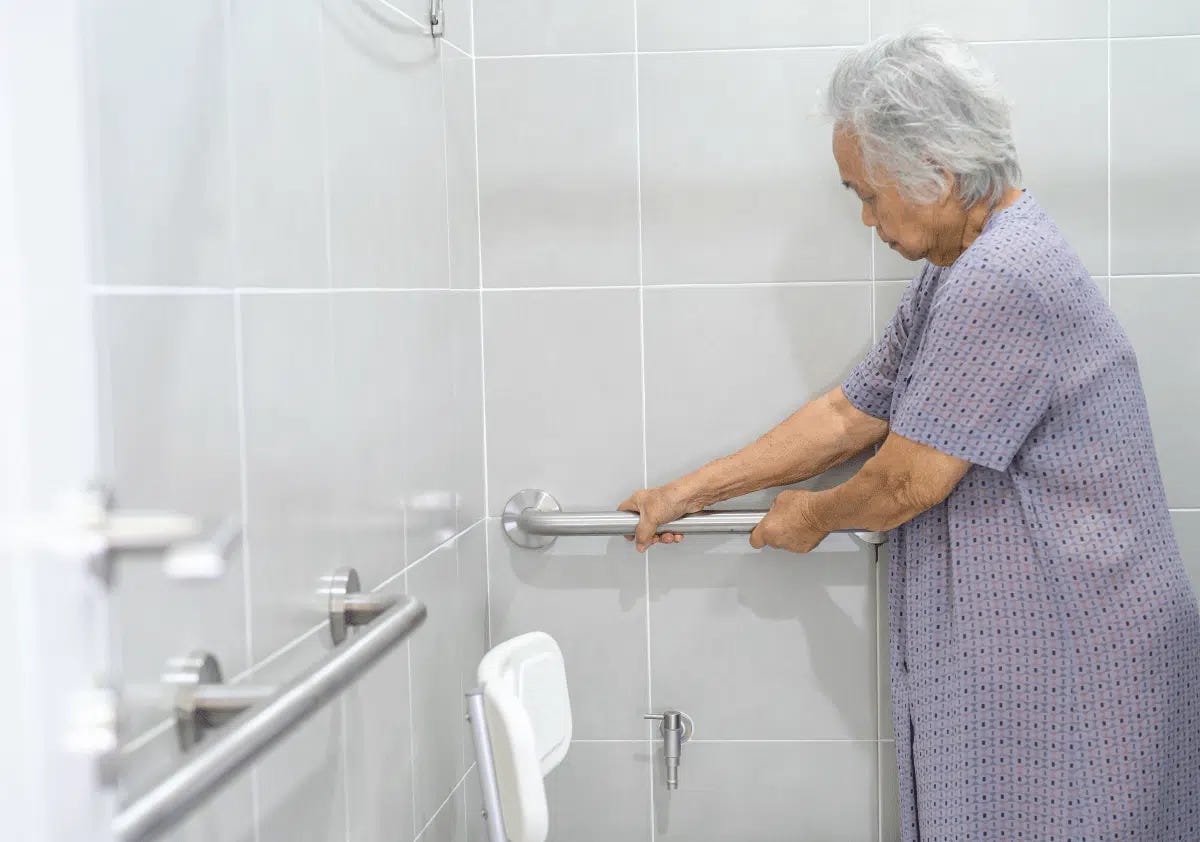
Today, more people with Alzheimer’s and dementia stay in their own homes - not just because they want to, but because financially they can’t afford to live in a care facility. While we all want our loved ones to have the comfort of home, we must ensure their environment is safe.
The bathroom is universally recognized as the most dangerous room in the house - especially for falls. Grab bars are essential for individuals with Alzheimer’s because they provide the stability and support to reduce the risk of slips while navigating showers, bathtubs, and toilets. In fact, the Alzheimer’s Association explicitly recommends installing them as part of their overall home safety guidelines.
My wife, Linda and I have recently encountered a frustrating challenge trying to get grab bars installed in our Greensboro, North Carolina, apartment. Before I dive into our struggles, I want to share some vital information on why these safety features are so critical.
Why Grab Bars Are A Necessity
High Fall Risk: Slippery tile, wet surfaces, and physical weakness make bathrooms a primary hazard zone.
Cognitive and Visual Changes: Alzheimer’s disease affects spatial awareness and depth perception, making stepping over a tub edge or lowering onto a toilet difficult and disorienting.
Visual Contrast: Using grab bars in a color that contrasts sharply with the bathroom walls helps individuals with cognitive decline actually see, recognize, and use them.
Safety vs. Towel Rails: Regular towel bars or shower doors cannot support a person’s weight and pose a severe risk of snapping or pulling out of the wall.
Properly installed grab bars provide stable handholds that help people maintain balance and reduce the risk of slips and falls in wet bathroom environments. While many homeowners can install grab bars successfully, proper anchoring into structural wall framing or approved heavy-duty mounting systems is non-negotiable. If you are unsure of how to find the studs, professional installation is highly recommended.
Sourcing the Right Equipment
Grab bars are available in numerous styles and finishes, offering both style and functionality. You can find standard options at Home Depot, Lowe’s, and most local hardware stores. There are also specialty retailers, such as GrabBars.com that offer a wider range of sizes and application-specific models.
A critical warning: please avoid suction-cup grab bars. While they might offer minor balance assistance, they are notorious for pulling off the wall during an actual fall. Even Amazon includes an explicit warning on these products: “This shower grab bar is for BALANCE ASSISTANCE ONLY – DO NOT use it to support full body weight.”
Our Rental Bureaucracy Nightmare
Our new apartment did not come equipped with bathroom grab bars. Before we moved in, I informed the apartment management that both Linda and I required grab bars due to our age, health, and my recent Alzheimer’s diagnosis.
Management provided a form to be signed by a member of my medical care team, which we promptly submitted. Initially, I was assured that management would cover the installation labor if we provided the grab bars. A few weeks later, however, they backtracked, claiming they had miscommunicated and that we would be responsible for both labor and materials.
As a former remodeling contractor, I asked if I could install the bars to save money and ensure the job was done right. The response was a flat no. Hoping to find a workaround, I located a local non-profit organization that installs grab bars for seniors at no cost. Again, management blocked it. They were adamant that the installation had to be performed by a vendor they selected and approved.
Yesterday, they gave me quotes from two of their vendors. Both are absurdly expensive:
Vendor 1: $400 per grab bar (this includes labor and materials)
Vendor 2: $180 per grab bar (labor only)
In my professional experience, grab bar installations are typically quoted by the hour or as a flat rate for the entire project - not an astronomical fee per bar.
Know Your Rights and Plan Ahead
In researching the legal landscape, I discovered a harsh reality: under United States housing laws, landlords are generally required to allow reasonable handicap modifications, but they are not legally mandated to pay for them in private tenant residences.
Our apartment management company, Hawthorne Residential Partners, proudly states on their website, “Hawthorne’s “Live It” culture represents our promise to exceed expectations every minute of every day.” Presently, they have not even met our basic safety expectations.
If you or a loved one are preparing to move into a rental residence, I urge you to discuss the need for safety modifications long before signing the lease. Most importantly, get any agreement regarding installations and costs in writing. Don't let bureaucracy stand in the way of safety.
Full disclosure: My former home renovations company was an authorized installer for GrabBars.com. I am not being compensated by GrabBars.com.
Greg Rowland’s Alzheimer’s Journey is dedicated to honest reflection and thought-provoking opinions. While we build this publication into a self-sustaining platform through donations, you can support our sustainability plan via our GoFundMe. Reading, subscribing, and sharing this work with others is equally appreciated. Thank you for walking this road with us.
Support Greg Rowland’s Alzheimer’s Journey