


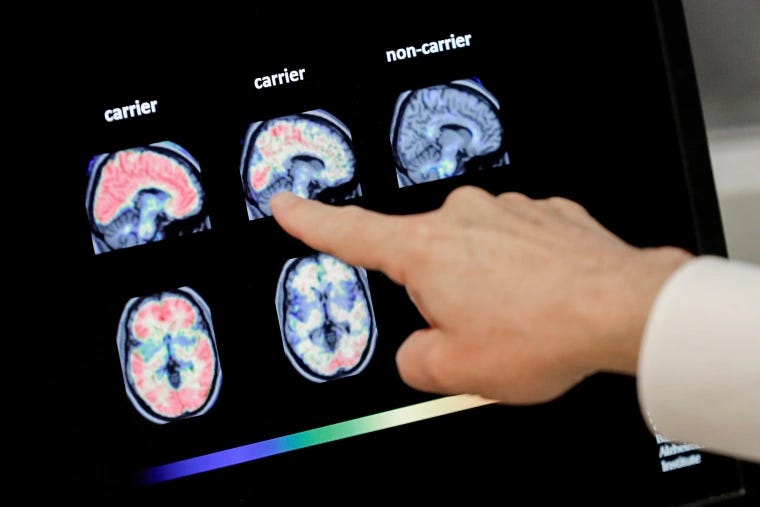
Several people asked me if a PET scan is necessary to diagnose Alzheimer’s disease (AD). Let’s take a deep dive into the most common and medically recommended AD diagnostic process. Keep in mind there are variances in the process depending on where you are located, your age, and your physician.
When Should You Or Your Loved One Get Tested?
The best answer I can offer is when there are persistent signs of cognitive decline, such as memory loss, confusion, or difficulty with daily tasks. This includes trouble remembering recent events and conversations. Challenges with planning and problem-solving could be signs of Alzheimer’s. Unexplained and unusual irritability and mood swings should be a concern. If one or more of these symptoms are occurring, and you are 60 years old or more, a visit to a primary care physician (PCP) is recommended.
If you need a bit more evidence that you are experiencing cognitive decline I recommend you take the SAGE test. A digital version is available from BrainTest. This is a free trial; although, you have to enter a payment method and cancel within thirty days.
On a personal note, I wish I had talked to my primary care doctor several years earlier than I did. Looking back, I had persistent memory and decision-making problems that I ignored.
What To Expect At Your PCP Visit?
I believe most primary care physicians will begin an initial examination with a discussion of your symptoms. It is helpful to have someone with you in case you have trouble remembering your symptoms. This discussion will likely include a family history of dementia and AD. Following this discussion, the physician may conduct a basic cognitive test. At that point, a complete set of blood tests will be ordered. These tests should include the newly approved Lumipulse G pTau217/ß-Amyloid 1-42 Plasma Ratio test.
Approved in mid-2025, Lumipulse G pTau217/ß-Amyloid 1-42 Plasma Ratio test is for the early detection of amyloid plaques associated with AD in patients, aged 55 years and older. The blood test is only administered if you are exhibiting signs and symptoms of AD. The Lumipulse G pTau217/ß-Amyloid 1-42 Plasma Ratio test measures two proteins, pTau217 and β-amyloid 1-42, found in human plasma, a component of blood, and calculates the numerical ratio of the levels of the two proteins. This ratio is correlated to the presence or absence of amyloid plaques in the patient’s brain, reducing the need for a PET scan.
The test requires a simple blood draw, although it is a fairly expensive test. The cost generally ranges from $600 to $1200.
An alternative to the blood test is measuring amyloid and tau levels in cerebrospinal fluid. This test can accurately identify most people with Alzheimer’s disease. The test is performed with a lumbar puncture, a 30- to 40-minute procedure, performed with a local anesthetic, to collect the fluid. This test would generally not be performed by a primary care physician.
If you have the Lumipulse G pTau217/ß-Amyloid 1-42 Plasma Ratio test and the results are positive, your primary care physician should refer you to a neurologist.
What Will A Neurologist Do?
This is a difficult question for me to answer. It depends on where you are located, on the experience of the neurologist in treating dementia and AD, and your age.
Assuming you have positive results from the blood test, the neurologist may order an MRI and/or a PET scan. An MRI scan will rule out other causes of your cognitive decline. With positive blood test results, it's becoming less common to have an MRI.
The PET scan is the most informative radiological method and many physicians consider it the gold standard for diagnosing AD. It provides an opportunity to actually see amyloid plaques and tau neurofibrillary tangle deposits in the brain tissue.
Of course, there are downsides to a PET scan. It is expensive, and it exposes you to a low level of radiation.
I believe as confidence in the Lumipulse G pTau217/ß-Amyloid 1-42 Plasma Ratio test increases, PET scans will decrease. Many neurologists will likely disagree with me. There are many advantages of a PET scan to determine the best treatment plan.
I am glad my neurologist ordered a PET scan because I have a baseline of the amyloid plaques and tau neurofibrillary tangle deposits in my brain prior to treatment. This will be helpful as future PET scans are administered.
In summary, please do not hesitate to talk to your primary care physician if you are experiencing memory issues, confusion, or trouble making decisions. The earlier you can be diagnosed, the more treatment options you have. You may have Mild Cognitive Impairment (MCI). This is not an actual disease, but rather a symptom of underlying brain changes (for example, AD), stress, depression, or temporary physical issues. MCI can be managed by lifestyle changes, stress reduction, and social engagement. People with MCI have a higher risk of developing Alzheimer’s disease; although, not all do.

My Alzheimer’s Journey does not offer paid subscriptions. Instead, we depend on subscriber donations to cover the cost of research and writing. Additionally, all donations support my direct and indirect Alzheimer’s treatment expenses. Thank you.
Donations
Shopping
About
Interested In Greg Speaking At Your Event?
Search