



After Dr. Alois Alzheimer left Munich in 1912 “Alzheimer’s disease” almost disappeared from research, scientific, and medical circles. AD was seen as a very rare disease restricted to young individuals.
In 1945, after two World Wars, two United States psychiatrists Dr. Adolf Meyer and Dr. Smith Ely Jelliffe revitalized Alzheimer’s research. Born in Switzerland in 1866, Dr. Meyer is considered to be one of the most influential figures in psychiatry in the USA in the early twentieth century. It is important to note that Dr. Meyer often exchanged thoughts and ideas with Emil Kraepelin (the doctor who named Alzheimer’s in 1910 and the author of Kraepelin’s Psychiatry). Dr. Meyer had been hired as the director of a newly established psychiatric clinic at the Johns Hopkins Hospital in Baltimore. He wanted to utilize Dr. Kraepelin’s clinical approaches at John Hopkins. Dr. Jelliffe was an American psychiatrist who worked in New York City. He was the long-term editor of the highly influential Journal of Nervous and Mental Disease.
Drs. Meyer and Jelliffe focused their research on abnormalities and features of this presenile form of dementia (Alzheimer’s disease). A major focus in their investigations was put on the plaques and tangles that were introduced by Dr. Alois Alzheimer among other anomalies in the brain of Auguste Deter.
In 1948, another American doctor, Louis Goodman, presented his ideas on the cause of Alzheimer’s disease at a meeting of the American Psychiatric Association. Dr. Goodman was the first person to discuss the potential differences of Alzheimer’s disease and senile dementia. He also talked about possible metabolic foundations of Alzheimer’s disease, and he speculated on a possible role of microglia and a disturbed iron homeostasis. This was the beginning of an understanding that there were overlaps of the pathology of Alzheimer’s disease with other human neurodegenerative diseases and forms of presenile dementia.
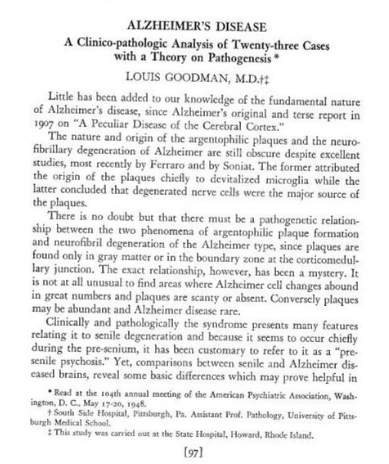
Dr. Goodman published an article in 1953 in which he presented an analysis of twenty-three cases of Alzheimer’s disease. Just like Dr. Alois Alzheimer, Dr. Goodman studied both clinical data and postmortem examinations of these twenty-three cases. In his article, Dr. Goodman said, “There is no doubt but that there must be a pathogenic relationship between the two phenomena of argentophilic plaque formation and neurofibril degeneration of the Alzheimer type.” Dr. Goodman’s research put plaques and the neurofibrillary degeneration in the spotlight.
During my research, I found this interesting excerpt from Dr. Goodman’s article: “It is not at all unusual to find areas where Alzheimer cell changes abound in great numbers and plaques are scanty or absent. Conversely, plaques may be abundant and Alzheimer disease rare”. This discrepancy indicates the confusion during the early years of Alzheimer’s disease research.
I believe the most important development of the 1950’s Alzheimer’s research is that AD was no longer understood to be a disease of young or middle-aged individuals as had been assumed by Dr. Alzheimer.
I hope you are enjoying exploring the history of Alzheimer’s research. I find it fascinating to learn about the research that laid the foundation of today’s search for a cure.
Thank you for your continued support.