



Since I skipped writing Wednesday (March 25), I am punishing myself by writing a serious post today. No Fun Friday for me this week!
I have been reading about how artificial intelligence (AI) is being used to enhance Alzheimer’s research and diagnosis. There are several successful AI utilizations across the globe. I think the two most promising AI deployments will be for dataset analysis and early diagnosis.
Today, I want to introduce you to StateViewer (photo below). Developed by the Mayo Clinic, StateViewer is an AI tool that helps clinicians quickly identify brain activity patterns of nine types of dementia including Alzheimer’s disease. StateViewer analyzes fluorodeoxyglucose positron emission tomography (FDG-PET) scans.
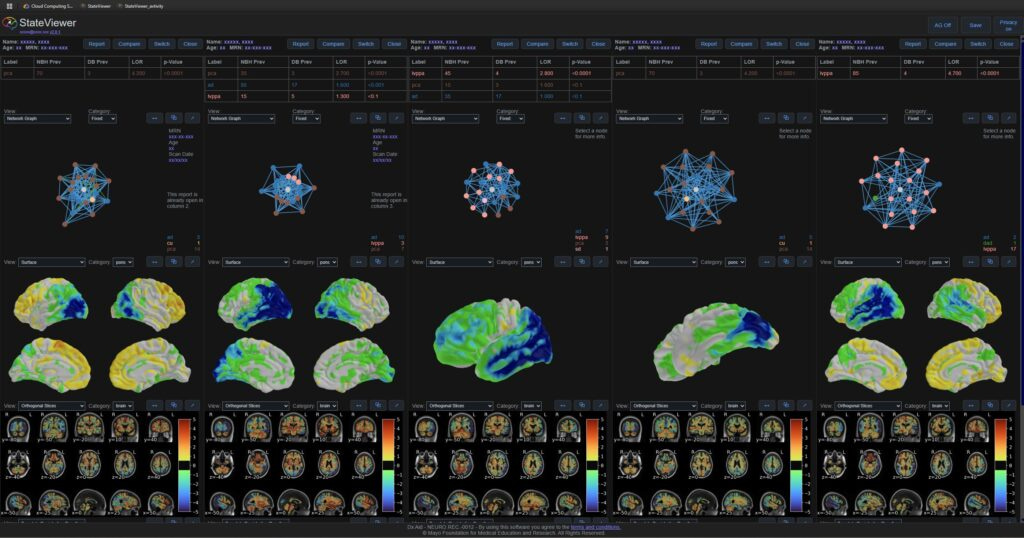
I always refer to a FDG-PET scan as a PET scan. Today, I learned that fluorodeoxyglucose (FDG) is the radioactive glucose analog tracer that you are given intravenously prior to the actual PET scan. Our brains run on glucose, so FDG is essentially marked glucose. The positron emission tomography (PET) scanner is a highly sensitive machine that detects the marked (glowing) glucose. The result is a 3D map of your brain using fuel.
StateViewer compares a patient’s FDG-PET scan to a large database of scans from people with confirmed dementia diagnoses and identifies patterns that match specific types, or combinations, of dementia.
Dr. David Jones (photo above), a Mayo Clinic neurologist and director of the Mayo Clinic Neurology Artificial Intelligence Program, says StateViewer is “a step toward earlier understanding, more precise treatment and, one day, changing the course of these diseases." Dr. Jones directed the development of StateViewer alongside Leland Barnard, Ph.D., a data scientist who is the brains behind the AI engineering driving StateViewer.
An article published June 27, 2025 in Neurology explains the methodology the Mayo Clinic used to gather the database of scans. There were 3,671 individuals with a mean age of 68 years. 49% reported as female. This article also reports that StateViewer helped researchers identify the dementia type in 88% of cases.
StateViewer enabled clinicians to interpret brain scans nearly twice as fast and with up to three times greater accuracy than standard workflows.
"As we were designing StateViewer, we never lost sight of the fact that behind every data point and brain scan was a person facing a difficult diagnosis and urgent questions," Dr. Barnard says. "Seeing how this tool could assist physicians with real-time, precise insights and guidance highlights the potential of machine learning for clinical medicine."
The Mayo Clinic continues to expand the tools’ use and evaluate its performance. I can envision a time when StateViewer is integrated into the FDG-PET scanner. As quick as a patients scan is complete, StateViewer is hard at work diagnosing the brain disease.
It appears that StateViewer is a big step forward in accurate and early diagnosis of dementia including Alzheimer’s.
I hope everyone has a great Spring weekend. Thank you for your continue support.
How cool! This is the best use of AI if you ask me. Any incremental improvement in the treatment of alzheimers and other historically hard to treat health concerns is great news. Can't wait to see how this technology evolves in the health care space. Thanks for sharing