


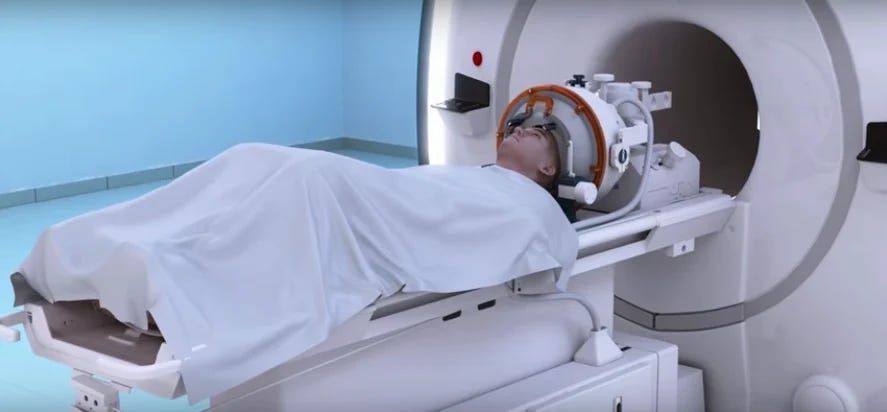
There are several active studies, trials, and early research underway related to Ultrasound Enhanced Drug Delivery. Clearly, a lot of companies, universities, and research organizations believe ultrasound is the best technology for penetrating the Blood Brain Barrier (BBB).
In 2023, the West Virginia University Rockefeller Neuroscience Institute conducted a proof of concept study to determine if focused ultrasound with microbubbles could open the BBB in patients with Alzheimer’s disease. This study had three participants. All had received a diagnosis of Alzheimer’s disease within the year before enrollment. None of the participants had previously received aducanumab therapy. According to an article in the New England Journal of Medicine, “During the 6-month combined-treatment phase, there was an opening of the blood–brain barrier in all focused ultrasound–targeted regions followed by closure of the blood–brain barrier within 24 to 48 hours after the procedure.” There was no cognitive decline in any of the participants. This study is still active; however, I could not find any specific information. I contacted WVA Rockefeller Neuroscience Institute and requested an update. They declined to provide an update.
Columbia University in New York City is planning a study to assess the “safety and reversibility of focused ultrasound induced blood-brain barrier opening”. This is a Phase 1b study. Columbia University has been actively researching ultrasound technology since 2020. Like WVA Rockefeller Neuroscience Institute, Columbia has completed a successful proof of concept study. The new study is indicative of Columbia’s commitment to ultrasound drug delivery system. An important element of this study is the “assessment of the therapeutic efficacy of FUS-BBBO (focused ultrasound induced blood-brain barrier opening) in reducing amyloid beta and neurofibrillary tangles.” Columbia hopes to launch the study in August of this year.
In 2018, Sunnybrook Health Sciences Center in Toronto, Canada, conducted a Phase 1 trial that became the first peer-reviewed published report on focused ultrasound technology. This study was supported in part by the Focused Ultrasound Foundation. The study used Insightec’s focused ultrasound equipment. Based in Israel, with offices in the United States, Germany, China, and Japan, Insightec is arguably the world’s leader in developing technology for incision-free surgery. Of course, they want to be the leader in ultrasound drug delivery. Sunnybrook completed a Phase 2a study in April 2025. The results have not been released.
I think it very important that Insightec has developed ultrasound technology that early studies indicate viability. I believe they will be first to market once they complete larger trials, and receive FDA approval. They are currently recruiting for a study to “evaluate the safety and efficacy of the ExAblate Model 4000 Type 2.0 System as a tool to disrupt the blood-brain barrier (BBB) in patients with probable Alzheimer's Disease.” This study should be complete in early 2030.
While conducting research for the article, I discovered that ultrasound technology is also being studied for treatment of neurological disorders that do not involve breaking the BBB. Here are a few examples:
Low Intensity Focused Ultrasound for Mild Cognitive Impairment and Mild Alzheimer’s Disease - University of California
Focused Ultrasound Stimulation of the Cerebellum to Induce Changes in Cognition and Brain Activity - University of Nottingham, England
A Pivotal Study of LIPUS-Brain in Patients With Early Alzheimer’s Disease - 19 locations in Japan
Low-intensity Hippocampal Transcranial Ultrasound Stimulation for Managing Cognitive and Sleep Dysfunction in Preclinical Alzheimer’s Disease - Chinese University of Hong Kong
I hope you found this article informative. Thank you for your continued support.
Donations are always appreciated.