


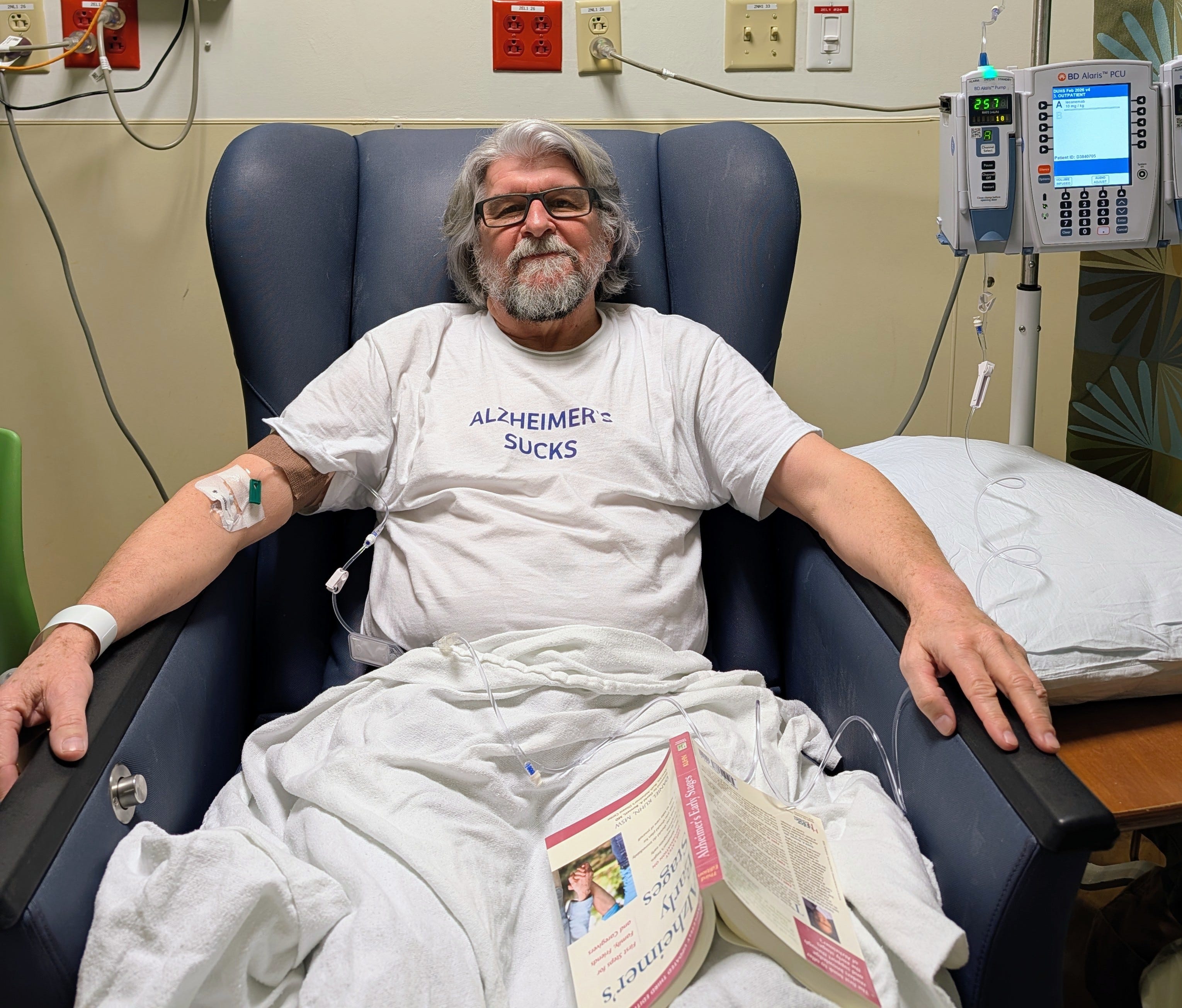
I had my 13th Lecanemab infusion this morning. I am too tired to do any deep research this afternoon. Instead, I am going to share the infusion experience with you. If you have never had an infusion or have never been with someone while they received an infusion, I believe you will find the experience interesting.
I arrived at the Duke Clinics at 8:40 this morning. The clinics are located on the primary Duke University campus and adjoined to the main Duke Health hospital. After entering the Cancer Center building and passing through a magnetometer, I walked toward the Cancer Center lobby. At the edge of the lobby is a staircase with an open design allowing people to look down to the lower floor or up to the upper floors. On the lower floor, a grand piano is visible. No one was playing the piano. I was a tad disappointed.
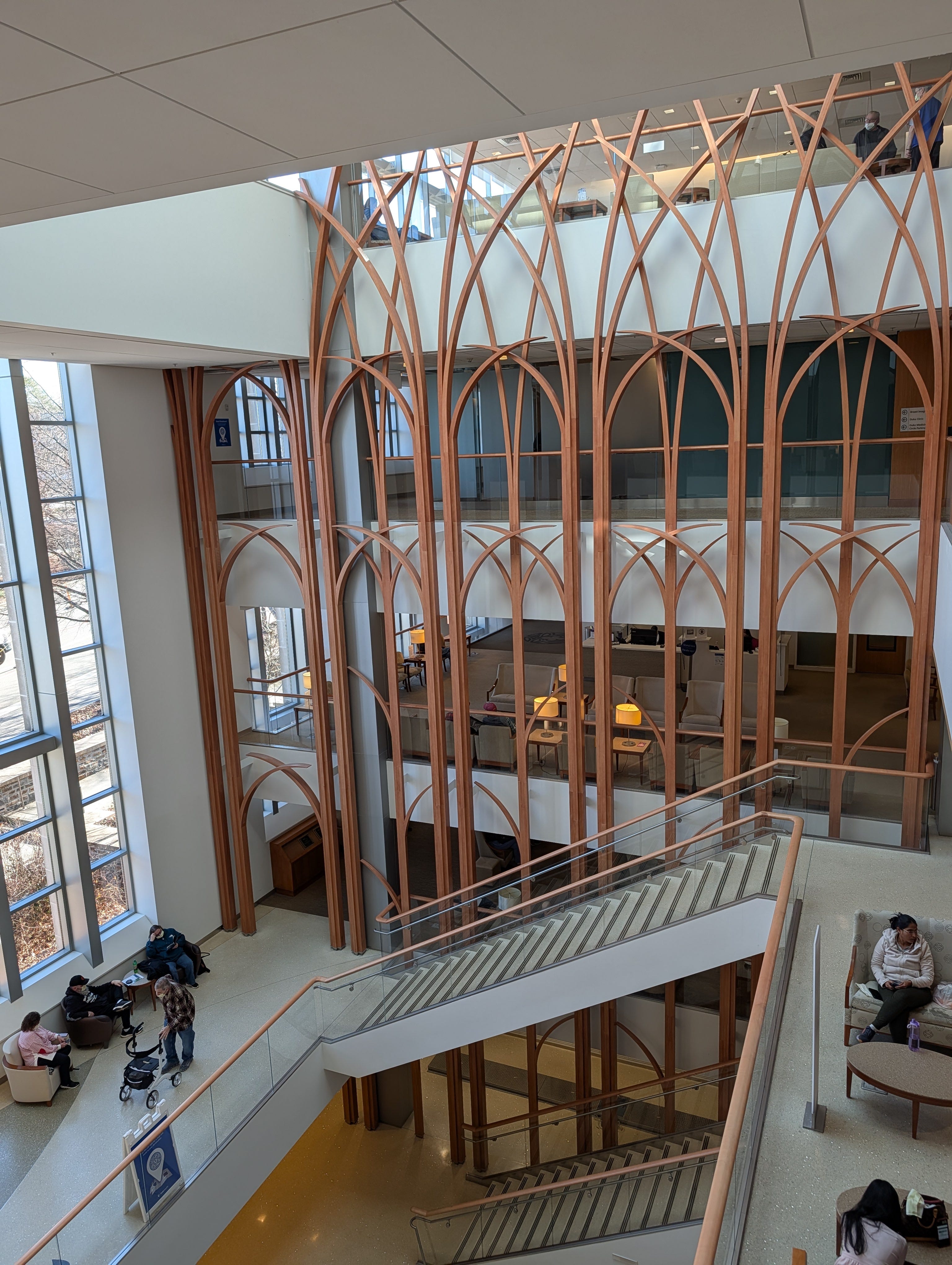
Continuing through the Cancer Center lobby, I arrived at a small single elevator. This elevator took me to the second floor. My destination was Clinic 2A, the Duke Specialty Infusion Center.
My appointment was at 9:15. I arrived at the reception lobby about 9:00. The room was packed with patients and caregivers or family members. As always, the initial check-in process was efficient. After my wristband was printed and placed on my right arm, I was handed a clipboard and a dry-erase marker. The clipboard had a laminated sheet with maybe a dozen questions. The questions ranged from, ‘how do you feel today,’ to ‘do you have Covid.’
I found an empty chair and completed my questionnaire. In about five minutes, a nurse came to get me for part two of the check-in process.
On one side of the reception room is a curtained area where two nurses weigh each patient and check their vital signs. Weight is important because for most infusions, the amount of the drug you receive is determined by your weight. If time allows, these nurses place the infusion port in your arm or hand.
I was weighed and my blood pressure and pulse were checked and recorded. The information on my clipboard was transferred to my medical chart.
This process of recording the critical information needed for a safe and effective infusion, not only updates my medical chart, it notifies the staff in the infusion center that I am ready to have my infusion port installed, and it provides the pharmacy my current weight.
The process has obviously been carefully designed to achieve maximum efficiency without compromising on patient comfort and safety. It reminds a bit of a restaurant system where the waiter enters the customers order in a handheld wireless device. The kitchen receives the order and the chef/manager plans for the meal preparation and eventual delivery to the customer.
It was decided that my IV portal would be placed into my arm or hand after I go to the infusion center. Most importantly, the pharmacy has queued my Lecanemab order among the dozens of drug orders they continually process.
I returned to my seat and within five minutes Nurse Thea greets me. She checked my wristband, and we walked across the hall to the infusion center. Nurse Thea remembered me from a previous infusion several weeks ago. Her demeanor was friendly and calming.
You are never assigned the same infusion nurse two appointments in a row. I assume someone with a lot of education and experience determined the benefits of moving nurses around from patient to patient. My guess is the infusion center has about 100 patients each day. Each patient is unique in the drug they receive, the disease being treated, and their level of anxiety.
I looked around the room, and I am disappointed that the new chairs and curtains have not arrived.
The current chairs are a tad worn and some do not recline without a shove or two. The curtains are ugly, old, and faded. I have been told replacements are on the way.
Nurse Thea took me to my chair and another staff member appeared like magic.
I call the other person the Queen of Comfort. She has one of the most important tasks - taking warm blankets to patients and tucking them in as needed. She does a lot of other very important things, but the blankets are what I remember.
Working efficiently and following patient safety protocols, Nurse Thea brought my pre-infusion medication and a cup of water. She scanned my wristband and asked me my name and date of birth. I took the medication under Nurse Thea’s watchful eye.
Next in the process is the dreaded IV port installation. I am sure there is a more appropriate word than installation, but it sure feels like they are installing the damn thing in me.
Nurse Thea searched for a vein very methodically. She located her target, cleaned the area, and suddenly with no pain the needle was in my left arm.
Now the wait began.
I pulled out my book and my phone and I passed the time reading. Before too long, Nurse Thea returned with my bag of Lecanemab. She again scanned my wristband and asked me for my name and date of birth.
I admit that my memory is failing; however, I still remember my name and when I was born. Is Nurse Thea testing my memory or does she think an imposter took my chair? Safety first I suppose.
It took about ten minutes (maybe less) to connect the Lecanemab to the pump and me to the pump.
I almost forgot the awesome snack guy. I can’t remember his name (Alzheimer’s is killing my memory). This cool volunteer wanders around the infusion center pushing a snack cart. I envision him as a secret snack dealer handing out goodies to all the patients. It is not just the snacks he freely gives you, it is his friendly and calming personality. Mr. Snack Guy is loved by all the patients.
I dozed off for a bit while the Lecanemab flowed into my blood stream. The combination of a warm blanket and Benadryl put me to sleep quickly. I hope my snoring wasn’t too loud.
It is hard to describe the relationship among the patients on the same schedule. It isn’t that we are becoming friends - of course, that could happen. The relationship is more like comrades. We are all stuck (literally) in this big room being fed a drug that we hope will make us healthier.
Eventually, my IV pump beeped and Nurse Thea returned. She shakes the IV bag and told me she doesn’t want to waste any Lecanemab. You go Nurse Thea, that stuff is liquid gold.
Before long, I am disconnected, the IV port is removed, my vitals are checked, and Nurse Thea officially releases me.
It is nice that I no longer have to wait and see if I have any nasty reactions to the infusion. Yet, what better place to nap than under a warm blanket among my comrades?
Just like a busy restaurant, they have to turn the chairs, so I packed up and wandered back to the beautiful lobby. Still no piano player. Maybe in two weeks.
The Duke Specialized Infusion Center is a very special place (see what I did there?). It is a well-organized team of professionals focused on one thing - giving personalized care to patients undergoing a procedure that is far from fun. It may be like a group of ducks moving rapidly across a pond - smooth, peaceful, and graceful above the water and paddling as hard as possible underneath the water. As a patient, I only see the results of the underwater work. Thank you Team Duke.
Before I sign off today, I have a short video I want you to watch. A friend in Texas (Erin), is genetically destined to develop Alzheimer's disease. Erin is also a young mother of two, a wife, an entrepreneur, and an artist. Her dad has Alzheimers disease and in 2023, Erin learned that she carries the same genetic mutation he does–a rare mutation that causes a person to develop Alzheimer's Disease. She can tell you more as you watch her videos. There is one video in particular that caught my attention yesterday. She addresses the same issue I did last week - the stigma surrounding mental illness and in particular, Alzheimer’s.
Thank you for being a part of my journey.
My Alzheimer’s Journey is a reader and subscriber funded blog. We do not solicit subscriptions. Instead, donations are greatly appreciated. Thank you.
Thanks for sharing your experience and my videos, Greg!