


Diagnosing Alzheimer’s disease (AD) is a complex and complicated process. I believe the steps I took for my diagnosis are fairly common. I visited my Primary Care Physician who ordered an MRI. He also gave me a cognitive test and ordered complete blood testing. The results of those tests took me to Duke Neurology in Durham, North Carolina. A Duke neurologist administered a more complex cognitive test, a neurological exam, a medical history review (including my family), and ordered additional lab tests, including a ApoE genetic test. A week later I returned to Duke and had a PET (positron emission tomography) scan. The scan showed a buildup of Amyloid plaques in my brain. Combined with the other supporting evidence (cognitive testing, medical history, and genetics testing), I was diagnosed with early-stage Alzheimer’s disease.
A PET scan uses a radioactive substance known as a tracer to detect substances in the body, or in the brain alone. PET scans of the brain show clusters of amyloid proteins and neurofibrillary tangles. High levels of amyloid proteins are a hallmark of AD.
Most hospitals use a Siemens PET scanner that is based on technology developed twenty-five years ago. Considering the importance of PET scans for diagnosing cancer and neurological diseases, it surprises me that new technology has not been developed in twenty-five years.
The wait is over! A consortium that includes United Imaging, University of California at Davis, and Yale University have developed the next generation of the PET scanner. Called the NeuroEXPLORER (NX), the scanner outperforms the current PET scanner with these attributes:
10-fold sensitivity increase
over two times the spatial resolution
can detect signals from much smaller structures
overall greater image detail
At the 2024 SNMMI Conference (Society of Nuclear Medicine and Molecular Imaging), the NX was the darling of the show and its images won the show’s coveted Image of the Year honors.
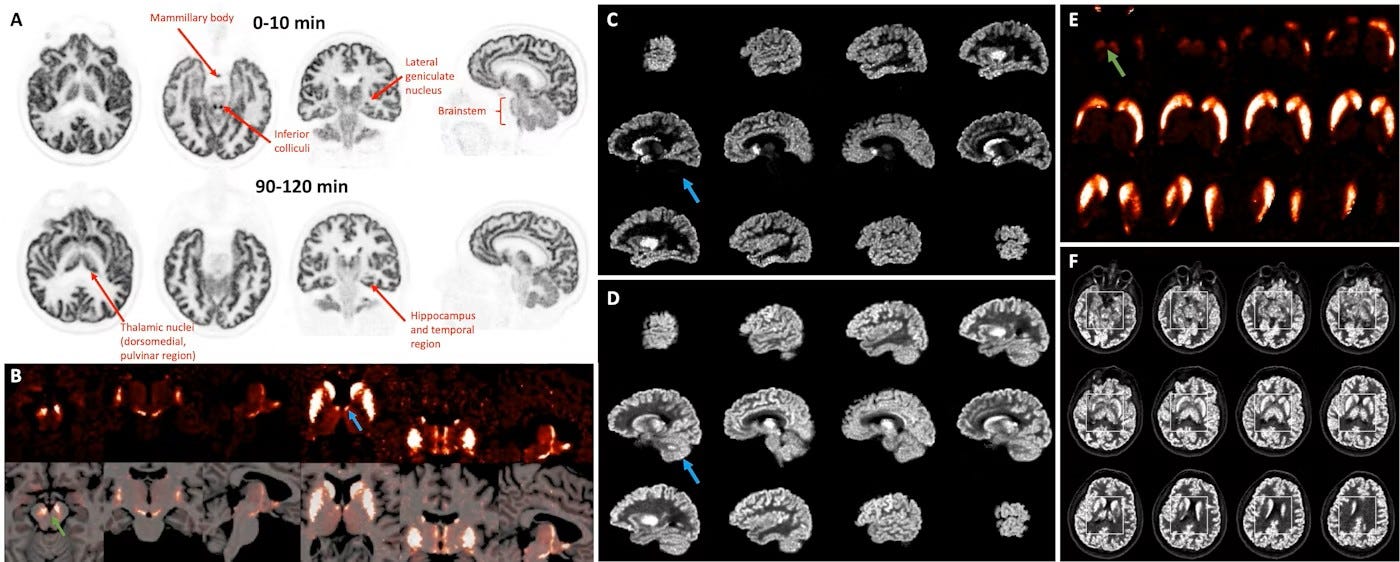
An article in the Journal of Nuclear Medicine stated, “The NeuroEXPLORER offers high sensitivity and high spatial resolution. With its long axial length, it also enables high-quality spinal cord imaging and image-derived input functions from the carotid arteries. These performance enhancements will substantially broaden the range of human brain PET paradigms, protocols, and thereby clinical research applications.”
For nearly fifty years, PET technology has been a valuable tool for assessing changes in the brains blood flow, metabolism (energy), and receptor occupancy resulting from medication or cognitive stimulation. As AD research expands and evolves, the current PET technology has numerous limitations.
The NX is an amazing advance in imaging technology. For example, the NX is equipped with motion-tracking hardware that eliminates the problem when a patient moves their head during the scan. Currently, even the slightest head movement causes a motion artifact.
In addition to its value as a clinical tool, the NX promises to have a significant research role for investigating some of the most fundamental questions about brain function and pathology. I believe the NX will allow a deeply comprehensive study of AD that will lead to a cure. That is my prediction.
While the NX appears to be a game changer in diagnosing and studying AD, Parkinson, and other neurological diseases, United Imaging has not submitted the NX to the FDA for clearance and at present is only for research use. I contacted United Imaging and requested an update on their plans to submit the NX to the FDA for clinical approval. They have not responded yet.

My Alzheimer’s Journey does not offer paid subscriptions. Instead, we depend on subscriber donations to cover the cost of research and writing. Additionally, all donations support my direct and indirect Alzheimer’s treatment expenses. Thank you.
Donations
Shopping
About
Interested In Greg Speaking At Your Event?
Search