


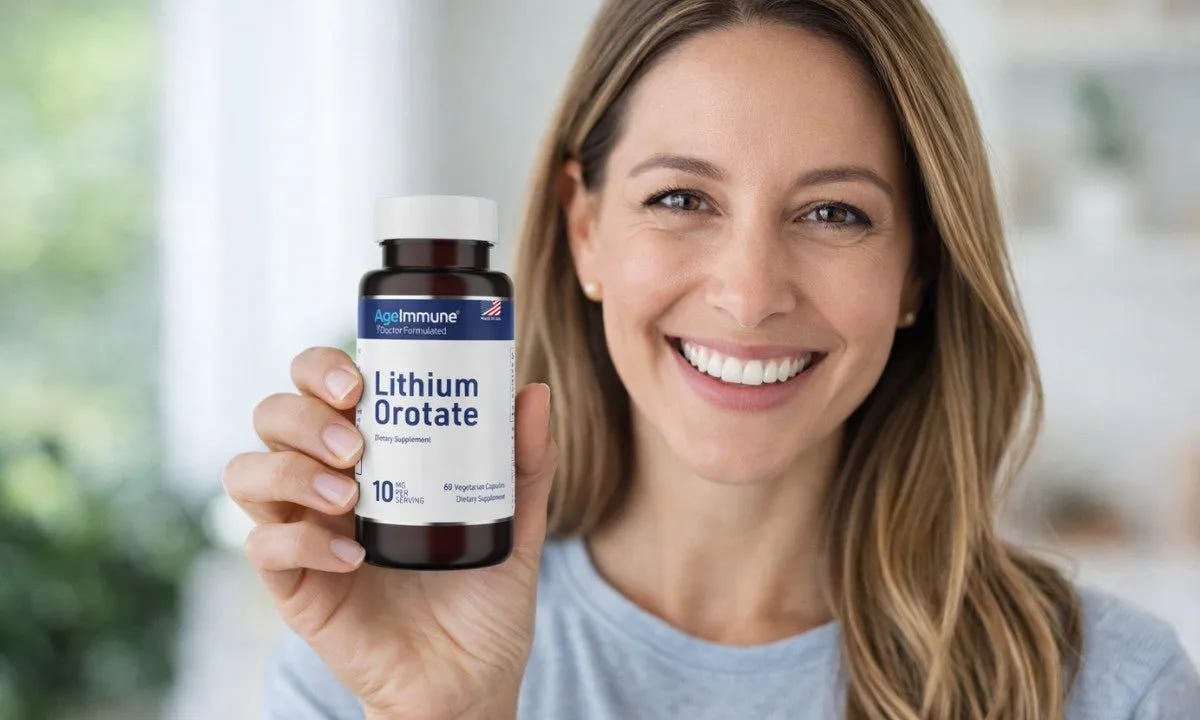
A few days ago, someone on Reddit asked about lithium orotate for his mother who has Alzheimer’s disease (AD). He stated that he wanted to start her on a 5mg dose. He also said he asked his mother’s geriatrician about giving her lithium orotate. The geriatrician suggested it would be best if he could find a clinical trial for his mother. He posted in the Reddit Alzheimer’s community asking if anyone knew of a lithium orotate clinical trial. Someone quickly responded with a link to a Johns Hopkins trial. The original poster followed up and questioned if he should put his mother through a clinical trial or just give her the lithium orotate himself.
I responded with this rather lengthy reply:
You did not give your mother’s age and how many years she has had Alzheimer’s disease. I think those facts are important in considering her taking lithium orotate.
Regardless of her age and Alzheimer’s progression, I strongly encourage the Johns Hopkins clinical trial. This is a short trial managed by a top medical university. Your mother will have the best of care at Johns Hopkins. She will be contributing to a major research project that potentially will positively impact millions of Alzheimer’s patients for years to come.
I have studied lithium orotate somewhat extensively. My conclusion is that it has the potential to make Alzheimer’s patients feel better; but, I question its ability to actually treat the disease.
Lithium orotate is an unregulated natural supplement. That doesn’t necessarily make it good or bad.
A concern I have is the quality of the supplement. Are you buying a supplement from a pharmaceutical grade manufacturing facility? Or, is the supplement made in a basement in a third world country. This is why regulations are important from a safety and purity perspective.
I have no real opinion on lithium orotate. Many people have made amazing claims that the supplement actually treats Alzheimer’s. To the best of my knowledge, most of these claims are anecdotal.
It is time for clinical trials. In my opinion, Johns Hopkins is well suited to conduct this trial.
I am aware that lithium orotate is a hot topic within the Alzheimer’s world.
The interest in lithium orotate apparently began last year with the publication of a few studies. In addition to the legitimate studies, Amen Clinics published an article titled, New Hope for Alzheimer’s: Study Says Lithium May Reverse Aging Brain. The article is based on a 2025 study published in Nature.
The Amen Clinics article makes several bold statements:
“This breakthrough points to a future where a safe, natural element could transform how we treat one of the most devastating brain disorders of our time.”
“the researchers found evidence in mice that lithium orotate—a specific type of lithium supplement—undoes memory loss and reverses neurological changes, helping to restore the brain to a healthier and younger state in subjects with AD.”
“the implications of this latest finding are profound. With clinical study, it could potentially lead to new and effective treatments for Alzheimer’s disease—and perhaps even Alzheimer’s prevention supplements of lithium orotate.”
The 2025 study published in Nature is a Harvard University study designed to gain “a fundamental understanding of the pathogenic processes leading to memory loss”. The Harvard researchers stated, “Of the metals we analyzed, Li was the only one that was significantly reduced in the brain in individuals with mild cognitive impairment (MCI).”
Lithium (Li), discovered in 1817, is a naturally occurring metal in the earth’s crust which in the solid phase is the least dense of all elements. In the form of carbonate (Li2CO3), it has become one of the most frequently used pharmaceuticals in psychiatric treatment owing to its normothymic (stabilized mood) effects.
I could write an entire article on Lithium (Li). It is a fascinating compound. Let’s stay focused on lithium orotate, though. There is a big difference between lithium orotate and therapeutic lithium. The brand name for therapeutic lithium is Lithium Carbonate.
Lithium affects the flow of sodium through nerve and muscle cells in the body. Sodium affects excitation or mania. Therapeutic, oral doses of Lithium Carbonate are usually within the limits of 600–1200 mg Li2CO3 per day. This is very dangerous drug. Lithium toxicity can cause death. Lithium Carbonate has a narrow range of safety. Toxicity can occur if you take only slightly more than a recommended dose.
Lithium orotate is a nutritional supplement. It is widely available in the United States (and presumably in most countries). Like most nutritional supplements, the sellers make claims to lure people to pull out their credit card. BrainMD (owned by Amen Clinics) states, “Feeling emotionally reactive or mentally scattered? Lithium Orotate delivers low-dose nutritional lithium—a trace mineral studied for its calming effects on mood, stress, and brain health.” BrainMD also has a disclaimer, “This low-dose lithium supplement is a nutritional formula, not a prescription drug. It is not intended to replace any medication or medical treatment.”
Another online seller, Life Extension, calls their product, “Lithium”. Under “Supplemental Facts” Life Extensions says “Lithium (from lithium orotate)”. I assume the name difference is simply a branding ploy.
Life Extension sells 100 1000mg capsules for $12. BrainMD sells 60 5mg capsules for $13.95. The reason Life Extension has a 1000mg capsule is that they combine lithium orotate with microcrystalline cellulose (a purified, partially depolymerized cellulose derived from refined wood pulp, commonly used as a versatile, safe excipient, binder, filler, and anti-caking agent in pharmaceuticals, foods, and cosmetics.)


Have I convinced you that lithium carbonate needs a clinical trial?
The Johns Hopkins University study is currently recruiting participants. According to ClinicalTrials.gov, the study is described as follows:
The goal of this clinical trial is to assess feasibility, safety, tolerability, and central nervous system target engagement of oral lithium orotate in adults with biomarker-confirmed early Alzheimer’s disease. The main questions it aims to answer are:
Can participants be recruited, retained, and remain adherent (target ≥80%) over 9 weeks of treatment, and what is the frequency and severity of adverse events?
Does lithium orotate increase cerebrospinal fluid (CSF) lithium concentration from baseline to 9 weeks compared with placebo? Researchers will compare daily lithium orotate to matched placebo to see if lithium orotate demonstrates acceptable feasibility, safety, and tolerability and engages the central nervous system target (CSF lithium).
If you are interested in participating in the clinical trail, the contact is:
Christopher Morrow, MD, MHS
410-955-5147 or cmorrow3@jh.edu
I don’t fault anyone for taking lithium orotate. As an AD patient, I may get desperate enough one day that I will try an unregulated nutritional supplement. Yet, I am a show me the proven data guy, so I plan to stick with Lecanemab.

My Alzheimer’s Journey does not offer paid subscriptions. Instead, we depend on subscriber donations to cover the cost of research and writing. Additionally, all donations support my direct and indirect Alzheimer’s treatment expenses. Thank you.
Donations
Shopping
About
Interested In Greg Speaking At Your Event?
Search