


I recently participated in a University of Texas at Austin student project. It was an honor to work with a Senior Neuroscience student on her project. Mia’s project involved her learning what daily life is like for someone with early stage Alzheimer’s disease. Our online communication culminated with a Zoom meeting yesterday. Mia asked about the toll my disease has taken on my wife, Linda. My response was rather lengthy as I explained that we were not prepared for the social, financial, and quality of life impact my disease would have on us.

Last night, I started thinking about the impact Alzheimer’s disease (AD) has on families. I spent several hours researching, reading, and learning about how families are effected and how they cope. Some of the information I found included dementia patients, not just people with Alzheimer’s.
A large 2024 study in the United Kingdom, stated, “Dementia can adversely affect the quality of life (QoL) of family members/partners of those affected. Measuring this often-neglected burden is critical to planning and providing appropriate support services.” During my meeting with Mia yesterday, I told her Duke Health did a phenomenal job preparing us for my infusion treatments with one exception - the personal and family burden. I believe the UK study is spot on when they talk about the “often-neglected” quality of life impact.
The UK study involved 711 family members/partners of patients with dementia and AD. The Family Reported Outcome Measure (FROM-16) was employed to measure the impact the disease had on the study participants. The FROM-16 comprises 16 items, each with three response options: “Not at All” (score=0), “A Little” (=1) and “A Lot” (=2). The 16 items are divided into 2 categories (domains): emotional (comprising 6 items, maximum score of 12) and personal and social life (comprising ten items, maximum score of 20). The two domains are calculated as a total summary. The lowest possible score of FROM-16 is 0, and the highest 32. The higher the total score, the greater is the negative effect on the family member’s quality of life.
The FROM-16 mean total score from the UK study was 17.48 (broken down as 7.86 for the emotional domain and 9.6 for the personal and social life domain.) Of the 16 items measured, “feeling sad”, “feeling worried, and “difficulty caring” had the highest mean scores. The study showed females experienced significantly more impact than males. Below is a chart showing the study results from the 16 items.
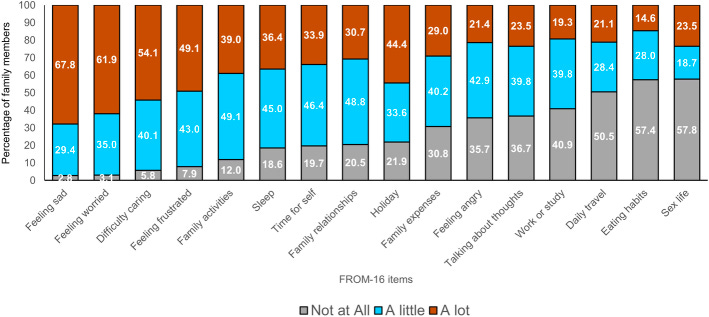
The UK study summarized their findings by stating, “family members/partners of people with dementia experience a very large negative impact on their QoL, limiting their personal, social, and emotional well-being, which is often ignored and excluded from healthcare policy, planning, and economic appraisal.”
Other studies and articles I read discussed the profound family changes that occur as AD progresses. In many cases family members take on new roles, with caregivers providing increasing support. These changes can lead to stress, as individuals may need to balance caregiving responsibilities with their daily lives.
MassMutual published a study in 2024 providing detailed information about the financial impact of AD. This statement resonated with me, “If a parent with Alzheimer’s makes poor financial decisions or gets scammed because of their illness, it can have ripple effects on the entire family. Even if they never make a bad decision, the cost of managing the disease can have a major impact on families.”
According to A Fact Sheet published in 2024 by the Alzheimer’s Impact Movement:
The lifetime cost of dementia is estimated to be nearly $395,000, including the value of unpaid caregiving
The lifetime cost of care for individuals with Alzheimer’s is more than twice the amount incurred by individuals without Alzheimer’s
For a Black family, dementia in the last five years of life consumes, on average, more than 80% of the family’s assets.
Linda and I are feeling the impact of my AD in several significant ways. I will share three examples.
We have a close friend and neighbor in South Carolina who would often join us on our screen porch after work. We laughed, relaxed, and shared stories. Words can not describe how much we miss Benard.
Linda and I were making plans and dreaming about a trip to Cuba and an Alaskan cruise. Those trips are certainly off the table now.
Financially, we simply were not prepared for my AD related expenses. As a small business owner, I experienced good years, combined with years when I struggled. Saving was a challenge. Especially, when you like to travel and enjoy life as Linda and I do.
A common topic among everyone impacted by AD is prevention. I think preparation is as important as prevention. As a global society, we need to do a much better job educating children and young adults about AD. We are reaching a point where the risk someone has for AD can be measured. With every passing year, we have a better understanding of AD prevention.
Let’s focus on preparation by teaching the basics of caregiving, having banks offer savings accounts specifically for AD (and other costly diseases), and developing policies that allow family members time away from their job to care for a loved one suffering with AD.
The impact of AD on families will always be harsh. It doesn’t need to be devastating though.

My Alzheimer’s Journey does not offer paid subscriptions. Instead, we depend on subscriber donations to cover the cost of research and writing. Additionally, all donations support my direct and indirect Alzheimer’s treatment expenses. Thank you.
Donations
Shopping
About
Interested In Greg Speaking At Your Event?
Search