


If you are a new subscriber to my blog, you can read the first two articles about the history of Alzheimer’s here and here. Welcome to Greg’s Alzheimer’s Journey.
There is very little documented research on Alzheimer’s between the mid-1950s until the late 1960s. In 1968, two British psychiatrists, Bernard Tomlinson and Martin Roth, began to investigate the importance of plaques in the brain. Also, in the late 1960s, the use of human brain tissue became more common for research. The study of human brains were essential to scientists to advance their understanding of dementia. These studies resulted in the pathogenesis, or origin, of various diseases and conditions to be understood as never before.
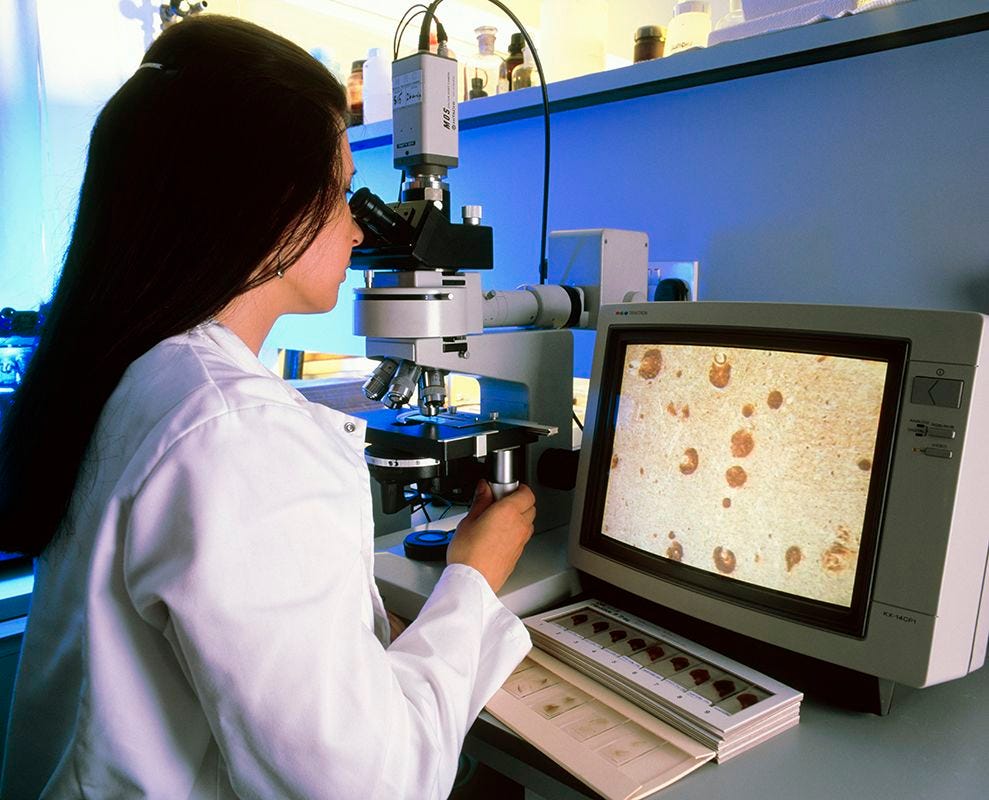
These studies led to the introduction of biochemical techniques that eventually helped scientists to understand how changes in the brain of certain individuals resulted in dementia. Most importantly, examination of brain biopsy samples using electron microscopy helped understand the detailed structure of plaques and tangles.
In the 1970s it became widely accepted that most patients with clinically defined senile dementia (onset of the disease after 65 years) have very similar pathological changes in their brains as patients in their presenile period (before age 65) with Alzheimer's disease. This was a huge discovery. The concept of Alzheimer’s disease was widened significantly. After about 1975, Alzheimer’s became a household name, synonymous with the most common form of severe, age-related memory loss.
In 1976, neurologist Robert Katzman wrote an editorial titled, The Prevalence and Malignancy of Alzheimer Disease. A Major Killer. Published in the Archives of Neurology, he identified Alzheimer’s disease as the most common cause of dementia, as well as a major public health concern, reigniting interest in and awareness of the disease.
In the early 1980’s, multiple neurotransmitter deficits were found in autopsy studies of seventeen patients with Alzheimer's disease. These studies started the clinical development of acetylcholinesterase inhibitors. In 1983, Hachiro Sugimoto at Eisai began development of donepezil. In 1996, the FDA approved donepezil (brand name Aricept) for treating mild-to-moderate Alzheimer’s disease. Eisai has been committed to seeking therapies for Alzheimer’s ever since. Collaborating with BioArctic, they developed Lecanemab beginning in 2005.
The development of Aricept is a fascinating story. I plan to write about it tomorrow.
Thank you to every one who visited the store last night and made a purchase. This morning, I designed a few new shirts for the Alzheimer’s Awareness Collection. These are my favorites. For Bonnie, I added a few bovine designs.

